

Cold Water - Chapters 20-22
Noir Mystery - the end of the mystery - codex to follow to close the book

Chapter Twenty: The Co-op
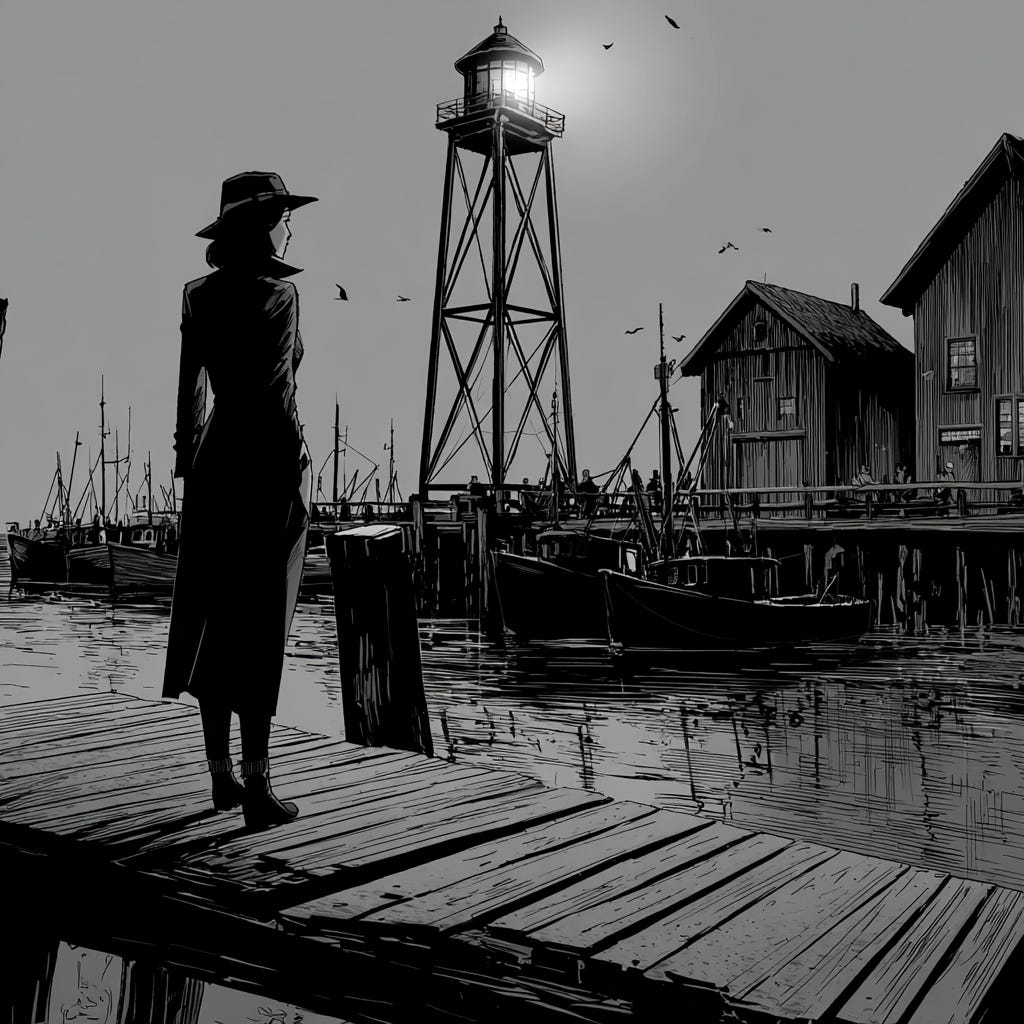
She was up before five again. She lay still for a while and listened to the water and then she got up and packed. It did not take long. She had not brought much, and she had not accumulated much—the notebooks, the files, the folders of printed documents that would travel separately through the official system. Her clothes. The credit card she had used to scrape frost from the windshield. The granola bars she kept buying and forgetting about.
The journal she did not pack. It stayed in the inside pocket of her jacket, which she put on last.
She made coffee and drank it at the window in the dark. The sound was invisible. The mainland was invisible. The island had contracted to the circle of the streetlamp and the few lights that were already on in the harbor—the co-op office window, she noted, lit again, the acting manager starting early or working through, the institution’s rhythm already adjusting to its new shape.
She had been on the island twenty-two days.
Purvis called at seven. She was loading the Jeep when the phone rang, standing in the hardware store’s back lot in the early morning cold with the bag over her shoulder. He said he wanted to see her before boarding the ferry. She said she’d be at the harbor road in ten minutes.
He was waiting on the harbor road when she pulled up, standing in the posture she had come to know—his weight forward slightly, the jacket collar up, a man who had been doing this job on this island for twenty-two years and would be doing it for three more before retirement..
She got out. He handed her a coffee in a to-go cup from the diner. She took it.
“Pauline said goodbye,” he said.
She looked at the cup. “I’ll go back in.”
“She said through me was fine.” He paused. “She said to tell you she’d been thinking about what she said. Thursday.” He looked at the harbor. “She said she’s still thinking about it.”
Anker looked at the harbor too. The fishing boats at their moorings, the fuel dock with its morning boat, a man on the dock doing something with a line. The co-op building with its lit window. The season’s last boats.
“Tell her I understand,” she said.
He nodded. He seemed to want to say something else and was deciding whether to say it. Finally, “The acting manager is Corrigan. David Corrigan.” He said this with the care of a man conveying information that had more than one layer of meaning—that the board had chosen one of the men referred for potential obstruction charges to run the co-op while the charges processed. “Nobody else would take it. He said he’d do it temporarily.” Another pause. “He was in that room.”
“I know,” she said.
“Both things,” he said. And then he stopped, because both things was the whole sentence and the rest was implicit.
She looked at the co-op building. Through the office window she could see Corrigan at the desk—she recognized him now. He was on the phone, working. The institution was functioning. The fall lobster season did not pause for what the institution had done to arrive at this moment, and forty-seven families were not going to wait for the legal process to resolve before deciding whether they could pay their mortgages. This was how it worked. This was how it had always worked. The knowledge of it was not the same as acceptance of it.
“It’s a good community,” Purvis said.
She looked at him. He was not asking her to agree with him in the way that made agreement into absolution. He said it the way he said things he had decided were true and needed to be said because the alternative was a silence that was its own kind of lie.
“Yes, I know,” she said.
He looked at her steadily. She looked back. They were both saying something that did not require elaboration—the community’s goodness and the community’s silence had existed in the same people at the same time, and that both were real. Neither cancelled the other, and this was fact rather than a paradox to be resolved.
She held out her hand. He shook it.
“Good luck,” he said. He had said this before, on the morning she told him about the upgrade. She had not known then what the luck would cost. She knew now.
She got in the Jeep. She drove to the ferry.
---
She sat on the car deck again on the way out, as she had on the way back from the interview. The car deck was where you kept things you were not ready to look at directly. She had the to-go coffee, and she drank it, looking at the ramp going up and the harbor behind it. The island shrinking as the ferry cleared the breakwater.
The co-op building was visible until the ferry turned. Then the church steeple, longer. Then the water tower. Then the spruce-covered center of the island, dark even in October morning light, the island’s permanent color. Then it all disappeared into the horizon.
She had arrived on a ferry in fog in the last week of tourist season, with a case file, expecting three days and a duty supervisor’s note that said the investigation would probably be routine. She was leaving on a ferry in the clear October cold with a report filed, a man charged, a community—most of whom knew something grievous had happened but decided to say nothing. She had a journal in her inside pocket that was evidence in an active investigation and also a small dark-green notebook that contained the diary of a young woman’s final eight weeks of life.
She considered that the entire island was complicit in murder if thought about in the right light. Dwelling on it would make no difference to the outcome. Nor would it improve her mood.
The mainland appeared ahead of her. She watched it come clear.
---
Chapter Twenty-One: The Report
She drove from Portwick to Portland without stopping. The coast road in October was quiet, the trees along the inland stretches turned and past their peak, the leaves mostly down, the branches showing. She drove with the radio off, which was a longstanding habit.
The state police headquarters in Portland was a building she knew after six years. She thought about it, not affectionately, not with dislike, but with familiarity. She parked facing the exit and went in.
Her supervisor was a man named Garrett who had been in Major Crimes for nine years and who read reports carefully, taking his time to absorb all the details. He read her report for twenty-five minutes while she sat across the desk and looked out the window behind him.
He set the report down. He said: “This is solid work.”
She said: “Thank you.”
He looked at the report and then at her. He was a man who had done this for nine years and had learned to read people across a desk the way she had learned to read rooms and interviews. She knew he was reading her now and knew what he was seeing. She had come back from four months of leave six weeks ago and gone directly to a twenty-two-day island posting and had sat in a room with a man who had let a woman drown in the dark rather than let a research report be submitted.
He held her gaze for a moment. “The manslaughter charge is going to take a long time.”
“I know.”
“Greer will argue the water, the conditions. She’s good.”
“Yes. The case is strong.”
“It is.” He picked up the report again and looked at the board member section. “Hallet’s statement is useful. Corrigan’s is less so but on the record.” He turned a page. “The Aalto referral—that’s going to be the prosecutors’ call. The records management argument is going to be difficult without the physical records.”
“I know.”
He set the report down again. He looked at her with the expression of a man who understood that the gap between what an investigation produced and what the system did with it was a gap you learned to carry or you stopped doing the work. “You did what you could do,” he said.
She did not say that doing what you could do was not the same as doing enough. She did not say it they both knew it and saying it would not change either of those facts. She said: “Yes.”
He nodded. He told her to take the rest of the week. She said she had the supplementary filings to complete. He said she could do them from home. She thanked him and left.
---
She drove home. Her apartment was on the third floor of a building on a street that had a coffee shop and a dry cleaner and a small grocery where she bought food when she remembered to buy food. She had been gone seven weeks. Seven weeks was long enough for the mail to overflow the box.
She brought in the mail and threw away most of it without opening it. She made coffee and stood at the kitchen window and looked at the city while it brewed. Portland from the third floor on a Tuesday in October—on the street below, a woman was walking a dog that was wearing a coat. The coffee shop across the street. A man reading something on his phone at one of the outdoor tables, which seemed optimistic for October.
The coffee finished. She poured a cup and drank it at the window.
She thought about the pasta and the promise of a life that had been wasted. She thought about the harbor at six in the morning with the color removed, and how you could see the shape of things better. She thought about Sunday phone calls that had stopped in August and a grieving father.
She drank her coffee. She looked at the city. After a while she went to the desk and opened the supplementary files and started work.
She had a follow-up appointment on Thursday, the second Thursday of the month, the way she always did. She had not missed one.
---
Chapter Twenty-Two: The Ferry Back
Six weeks later, on a Thursday in late November, she took the ferry to Harrower Island.
It was procedural—a statement to sign, a document that Purvis had flagged as requiring her signature in person, something that could have been handled by mail or by a trip to the Portwick county annex but that she had decided to do herself. She had called Purvis the previous week and told him she would come. He had said the ferry schedule had dropped to once daily. He said there was a room at Sprague’s if she needed it. She planned to go to the island and return in the same day.
The November ferry left Portwick at eight. The terminal parking lot was nearly empty—a few vehicles, a pickup with a lobster crate in the back, the truck of what appeared to be an electrician or plumber given the equipment visible through the rear window. No rental cars. No families with boogie boards. No one returning from somewhere else to a summer that was over.
She drove on last. She recognized the deckhand from her last trip in September.
She went up to the passenger deck. The morning was grey and cold, the sky and the water the same flat grey, the fog not thick but present, low on the water, the way it had been on the morning she first came. The Camden Hills were not visible. The mainland behind her was already diminishing, the terminal lights going out in the grey one by one until there was only the suggestion of the shore and then nothing.
She sat on the upper deck in the cold.
She had the journal in her bag, wrapped in the evidence release document that Garrett had signed the previous week. The investigation had not closed—it would not close for a long time, the charges pending, the board member referrals in assessment, Aalto’s matter with the prosecutors—but the journal had been released from the evidence record as a personal effect of no further investigative relevance. She had driven to the Portland evidence facility herself to collect it.
She had not opened it since the room above the hardware store.
She looked at the water. The fog was a familiar gray she had encountered on all her crossings to and from the island. It was the color that Voss had tried to paint twice and had not gotten quite right.
The island appeared out of the fog suddenly, the dark mass of spruce and granite resolving out of the grey, closer than expected, the harbor mouth coming around the rocky point. The breakwater wall. The dock pilings. The co-op building.
She looked at the co-op building from the water. The office window was lit. The fuel dock had one boat at it, a lobster boat running late in the season, the last of the fall fishermen still working. The parking lot had three vehicles. The re-painted sign was still brighter than the building around it. The building was the same. When the processes concluded, it would still be running because the island community needed it.
She went down to the car deck as the ferry came into the dock.
---
She did what she had come to do. Purvis’s office, the document, fifteen minutes. He had coffee made. She drank it. He made small talk, saying that the board members’ matter was moving slowly and that Corrigan was still acting manager.
She got in the Jeep and drove to the diner. Pauline was behind the counter. She looked up when Anker came in. She did not say anything. She poured a coffee and brought it to the table without being asked. She set it down and looked at Anker for a moment.
“Tom Voss,” she said. “He went back last week. To Ann Arbor.”
“I know,” Anker said. “I spoke with him.”
Pauline nodded. She went back behind the counter.
Anker sat for a while. She drank her coffee. She looked at the counter—the two stools, side by side, empty. The harbor through the window, the lobster boat moving through the breakwater mouth, the last of the season’s boats still working. The Red Sox pennant on the wall, slightly crooked, the same angle it had always been.
She finished her coffee and returned to the ferry.
---
She sat on the upper deck for the crossing. The island was behind her now. She watched until the fog took it. Then there was only the water and the sky, the ferry moving through the space between them.
She had the bag on the seat beside her. She did not open it.
The mainland was ahead of her. It was invisible as usual on this crossing—the fog too low, the distance too great, the grey too uniform. She sat with her hands in her jacket pockets and looked at where the mainland was.
The fog shifted. The shore resolved: the terminal buildings, the parking lot, the harbor road climbing away from the dock. The coast of Maine in November, functional and plain and exactly itself.
She looked at it for a moment. Then the fog closed again. The shore was gone.
She reached into the bag retrieving the journal. She held it in her hands for a moment—the soft dark green cover, the small size of it. The journal of a woman who had kept the window cracked because she liked to hear the water at night. Who had asked good questions. Who had kept painting the harbor even when she couldn’t get it right.
The fog lifted as the ferry came into the Portwick approach. The ferry slowed. The ramp went down.
She put the journal back in the bag. She picked up the bag and walked off.

Visit my Amazon Author page | Visit my Author website | YouTube Site