

Cold Water - Chapter 4

Chapter Four: The File
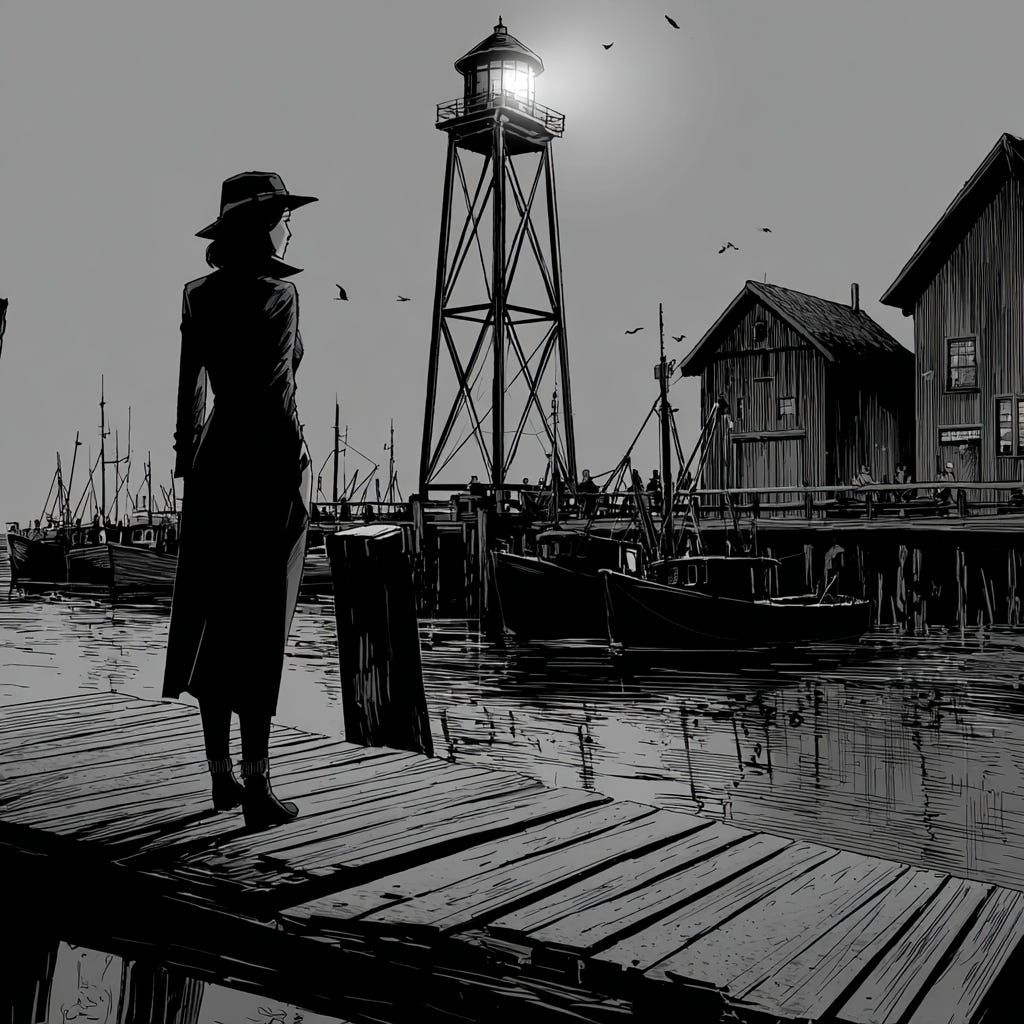
She took the seven-fifteen ferry. The sky was still dark when she drove onto the car deck and there were only three other vehicles — a contractor’s van with ladders racked on the roof, a pickup with a dog in the cab that watched Anker park with quiet professional interest, and a sedan with Massachusetts plates and, she guessed, had been here for the summer and was now going home. The woman driving it sat with her coffee and stared forward through the windshield with an expression Anker recognized as exhaustion from packing up a seasonal life.
She went up to the passenger deck and stood at the bow rail as the ferry cleared the breakwater. The island behind her was dark, except for the co-op building, which had lights on in the main office at this hour — the working day on the water starting well before sunrise. She watched the light in the window until the island was reduced to a shape, eventually fading from sight. The fog was not thick this morning but it was present, low on the water, and the crossing felt longer than it was.
Portwick came up out of the haze twenty minutes later. The ferry terminal was functional and plain — a concrete dock, a parking lot, a small waiting room she had walked through once and had no need to walk through again. She drove off the ramp and up the harbor road and turned inland at the light and followed the county road eleven miles to Rockland, where the Knox County Sheriff’s office occupied half of a civic building that shared its parking lot with the DMV and the county clerk.
Delvecchio was waiting for her in the lobby. He had apparently been watching the parking lot. He was forty-six and put together with the care of a man who believes appearance communicates competence, which it sometimes does. He extended his hand and used her first name before she had given it to him, which meant he had looked her up before she arrived. “Nora. Good to finally meet in person.”
“Detective Anker is fine,” she said pleasantly. “Thank you for making the time.”
A half-beat of recalibration. Then: “Of course. Come on back.”
His office was orderly in the performed way — the desk surface clear, a single file folder centered on it, a whiteboard behind him with three lines of text that she read upside-down from across the room: VOSS, M. / HARROWER ISL. / CLOSED. The closed was underlined once.
He sat behind his desk and she took a chair facing him. He opened the folder and turned it so she could see. “I pulled everything we have. ME report, witness statements, the photo set from the kayak recovery and the body recovery site, the BAC workup. It’s all in your copy.” He nodded at the second folder on the edge of the desk, which she already had in digital form. “I know the NOAA person flagged the field notes timing but we — in the context of an accidental drowning, the field notes are the research record. They’re not evidence of anything.”
“I understand why you made that call,” Anker said.
Something in him eased slightly at this. Not much, but enough to see. “She was out in conditions she probably shouldn’t have been in. The BAC wasn’t high, but it wasn’t nothing. The ME was thorough.” He gestured at the folder. “There was no reason to treat it as anything but what it presented as.”
“Walk me through your timeline. The morning of the twenty-ninth.”
He walked her through it. The sequence was what she already had — Kjell’s call at 6:12, county boat out by 6:52, body transferred to the mainland by 9:15, ME examination begun that afternoon. The kayak was logged separately — Machado’s call to Purvis, Purvis’ call to county, a county deputy driving out to the island on the noon ferry to photograph and collect it. She noted the deputy’s name from the file: Garza, T.
“Deputy Garza collected the kayak,” she said. “Did he examine the hull before transport?”
Delvecchio looked at the folder. “He photographed it. The photos are in the set.”
She had looked at the photos. The photos showed the kayak from the outside — hull, bow, stern, the location on the beach. No interior shots. “Did he note the condition of the interior hull?”
A pause. “It’s not in the report.”
“I examined the kayak yesterday at the fire station.” She kept her voice even. “The interior hull is clean. No water residue, no tideline. It wasn’t in rough water before it was beached.”
Delvecchio looked at her steadily. He was recalculating something behind his expression and doing it with the practiced composure of a man who has been in institutional friction before and knows how it goes. “That’s consistent with it being beached before the weather got bad.”
“The weather got bad around nine p.m. based on the NWS data. The ME puts her time of death at midnight or later. If she went in before nine in calm water, the BAC is harder to—”
“The ME’s window covers both scenarios.”
“It does,” Anker agreed. She looked at the whiteboard behind him and back at the folder. “I’m not questioning your process, Detective. I’m building a complete picture before I write my review. That’s the scope of what I’m doing.”
He held the composure. “What do you need from me?”
“The GPS coordinates for both recovery sites — body and kayak. I asked for them when we spoke by phone.”
He opened a desk drawer and produced a sticky note. He slid it across the desk. Two sets of coordinates, written in precise handwriting.
“And the NOAA field notes,” she said. “The complete set, including whatever Dr. Voss submitted to the shared server.”
“We didn’t request those. They’re not part of the case file.”
“I know. I’m requesting them independently. I wanted to flag that I’m doing that, as a professional courtesy.”
Something moved across his face — not quite displeasure, more the expression of a man watching a door he thought was closed begin to open. “You think there’s something in the research that connects to the drowning.”
“I don’t know what’s in the research yet.”
He looked at her for a moment. Then he nodded once and stood, and she understood the meeting was done. He walked her out to the lobby and shook her hand with the same professional warmth with which he had greeted her, and he said if she needed anything else from the county end she should feel free to reach out, and she thanked him and walked to the Jeep.
She sat in the parking lot for a moment. The DMV side of the building had opened, and a line was forming at the door — a woman with a folder of documents, an anxious teenager possibly about to take a driving test, a man in work clothes who had clearly been here before and was not happy about it. Ordinary Tuesday morning. The parking lot smelled of exhaust.
She took out her phone.
---
The NOAA regional office in Portland answered on the second ring this time and connected her to a field coordinator named Strauss who had been the one to flag the field notes in the first place. He had been waiting for her call and had the information ready to hand.
“The notes stop at eight forty-seven on the twenty-eighth,” he said, before she finished introducing herself. “Mid-entry. Not even a completed sentence. I know what research notes looks like when a researcher stops for the night, and I know what it looks like when they stop because something happened. That entry looks like she was interrupted—or something.”
“Can you send me the complete field note set? Everything from the duration of her survey — all entries, all timestamps, the GPS coordinate logs, any photographs she uploaded to the server.”
“I already have a folder prepared. I’ve been waiting for someone to ask for it.” He said this without irony, just the flat statement of a man who had been correct about something and had had to wait three weeks for anyone to agree. “Email or secure file transfer?”
“Secure transfer. I’ll send you the link.”
She sent him the link and waited. The file arrived while she was still in the parking lot — large, well organized, and precise. She opened the main field notes file on her phone and scrolled to the final entry.
August 28th, 8:32 p.m. The entry began with water temperature readings — three sampling points, coordinates logged, the numbers entered with the same methodical care as every other entry in the file. Then a brief note about visibility conditions, the sky still light enough at this hour to work. Then:
*North site water chemistry consistent with previous readings. Discoloration at grid ref NW-7 more pronounced than last week — the pattern is clear enough now that I’m confident in the source. Going to the dock to*
She read it three times.
Not going to the dock to check her boat. Not going to the dock to get out of the weather. Going to the dock to — something that required the co-op, or required Brask, or required someone whose office or vessel was at the dock. Going to the dock with a purpose she had been building toward for days, possibly weeks, based on what she had found at grid reference NW-7.
She did not know yet what grid reference NW-7 was. She did not know what the discoloration meant or what the source was. She needed someone who did.
She put the phone in her jacket pocket and looked at the DMV line, which had not moved. The teenager was still standing with his testing anxiety and the woman was still holding her folder of documents and the man in work clothes had given up waiting and was walking back to his truck.
She started her engine, thinking rapidly through the steps she needed to move forward in the investigation. It was beginning to look more intentional and less accidental.
---
She had three hours before the two-thirty ferry. She drove back to Portwick and parked on the harbor side. While she walked along the waterfront, she thought about what she had and what she needed. She had the kayak evidence — dry hull, placement angle, Machado’s account. She had the field note stopping mid-sentence. She had Tom Voss’ wind vector analysis, which her own examination of the shores had confirmed as a real problem. She had a vehicle track through spruce trees to the south shore that she had not yet followed. She had a co-op manager who had been at the constable’s office the morning after the body was found.
These things did not individually constitute anything. Collectively they constituted a picture that was developing in a direction that did not coincide with the ruling of accidental death on this case. What she had were interesting pieces that raised questions.
She needed the survey data interpreted. She needed to know what the discoloration at NW-7 was, what the source was, and whether it was the kind of thing a researcher would take to the co-op dock on the evening of August 28th. She needed a marine scientist with local coastal knowledge who could read Voss’ GPS coordinates and water chemistry data and tell her what she was looking at.
She took out her phone and called the NOAA field coordinator back. “The referral I asked for — a local marine science contact who could consult on current patterns and water chemistry. Did you have anyone in mind?”
“Knox County has a consulting biologist,” Strauss said. “He does environmental compliance work for them, aquaculture reviews, that kind of thing. Name’s Vasquez. Marco Vasquez. He’s based in Rockland. He’d be able to read Mara’s data, definitely.” A pause. “He’s good. Very good attention to detail.”
She wrote the name. “Do you have a number?”
He gave it to her. She wrote it below the name and put the notebook back in her pocket.
She stood at the end of the Portwick dock and looked at the water. The midcoast harbor here was different from Harrower’s harbor — larger, more varied, the working boats mixed with recreational craft still in the water this late in the season. A lobster boat was coming in at a steady pace, having probably been out since before dawn. The man at the helm was not looking at anything in particular, only at the water in front of him and the dock ahead with the competence of someone who had made the approach daily for years and years.
She would call Vasquez tomorrow. Today she needed to be on the two-thirty ferry.
She bought a sandwich from a shop on the harbor road and ate half of it walking back to the Jeep. She put the other half on the passenger seat and drove to the ferry terminal and parked in the lot. She opened the field note file again on her phone.
The timestamp before the final entry was 7:14 p.m. — also from the north shore, also water chemistry. The notes were the careful accumulation by a researcher who had been building toward something for six weeks. She read back through the last two weeks of entries. The north shore sites appeared more and more frequently as the survey progressed. The sampling points clustered tighter, the entries becoming more specific, the numbers she could not interpret appearing with greater emphasis. One entry from August 22nd said simply: *NW-7 again. Photographed. If this is what I think it is, it’s been going on for years.*
If this is what I think it is.
She put the phone down. The ferry was loading. She drove onto the car deck and cut the engine.
She had a researcher who had found something she believed was significant, who had gone to the dock to speak with someone about it and had not come back. She had a kayak with placement that didn’t make sense, a cut-off sentence, and a co-op manager who had been at the constable’s office by mid-morning of the following day. She had a vehicle track she had not yet followed.
She was not ready to call it anything, but she knew what she thought. She had known since she stood on the south shore in the early morning of Day 2 and looked at the angle of the rocks and felt the wind at her back pushing toward the water. She had been careful since then to keep knowing what she thought in a separate compartment from what she could demonstrate, because the discipline mattered and because getting ahead of the evidence was how cases came apart. She was going to keep being careful. She was going to follow each thread to where it led and document what she found. She had to let the picture develop at the pace it needed to develop.
But she knew what she thought.
The ferry cleared the breakwater and turned toward the island. She went up to the passenger deck and stood at the stern rail. The mainland was behind her now — the Portwick terminal lights, the harbor road, the civic building where Delvecchio’s whiteboard said CLOSED in underlined letters. The lights diminished and then the haze absorbed them and then there was only the water and the sky and the ferry moving through it.
She stood there until the mainland was gone.
The crossing in the dark was different from the morning crossing. The fog was lower and the running lights of other vessels appeared and disappeared in the grey, and the island came up suddenly — a mass of darkness that resolved into the harbor lights and then into the lights of specific buildings, the co-op’s office window was still lit, the diner’s sign was visible from the water, the hardware store was dark.
She thought about Tom Voss sitting in the diner with his folder of weather printouts and his quiet, factual questions, and she thought about Mara Voss on her stool every morning watching the harbor, and she thought about an entry dated August 12th, three weeks before her death, that said: *The harbor light at six in the morning is something. Like someone removed all the color from it. You can see the shape of things better.*
She recognized the phrase now. Tom Voss had quoted it in the diner, without knowing he was quoting his daughter’s written words — she had told him on the phone, described the harbor, and he had carried the description without knowing where it had come from. She had read it in the field notes in the parking lot in Rockland and not placed it immediately.
The ferry docked. She drove off the ramp into the darkness of the island. She parked behind the hardware store and sat for a moment. The sound was invisible but present, a steady low movement of water against the shore. The gap in the window frame above her would let it in all night. She had four things to do tomorrow: call Vasquez, follow the vehicle track on the south shore, request a formal file review through the state police, and re-examine the field notes’ GPS coordinates against the island map.
She took out her notebook and wrote: Day 5. Then she looked at what she had written across four days — the accumulation of small observations, each one not quite fitting, and the picture that was developing whether she intended it to or not.
She was not ready to call it anything. Not yet.
She wrote: NW-7. She wrote: going to the dock to — and stopped. She sat with the unfinished sentence for a while, in the dark, listening to the water.
Then she went upstairs to sleep.

Visit my Amazon Author page | Visit my Author website | YouTube Site